

Management Accounting
Understand what is driving performance. Provide your leadership team a clear basis for action.
Interested in management reports that reveal how your busienss is performing?

The problem we solve
A capable finance team keeps the accounts accurate and the month-end on schedule. Explaining what the numbers mean for the business is a different job, and it takes time, capacity and substantial commercial experience that most teams don’t have to spare.
The headline figures rarely tell the full story. Revenue can grow while margins shrink. A profitable project can quietly drain cash. Departments can stay within budget while delivery productivity slips. A standard profit and loss report shows the result, but rarely the cause.
Without that analysis, the CEO, board and investors end up asking the same questions every month:
What changed?
Why did it change?
Is it timing, or an underlying trend?
What should we do about it?
Auscorporate works alongside your finance team to turn financial and operational data into clear management reporting, commercial insight and practical actions, so leadership can stop asking what happened and start deciding what to do next..
Our approach - a reporting rhythm your business can use
Good management reporting doesn’t start with a template. It starts with the decisions your leadership team needs to make. We build reporting around how your business operates, how your finance team works and what your board and investors need to see. Then we update it as your business changes to keep it useful.
1. Understand the decisions
We start with your finance lead and leadership team. Together, we work out who needs the information, which questions the current reporting leaves unanswered, and which decisions your management accounts need to support. This could include a focus on priority questions like cash, margin, capacity and profitability reporting.
2. Establish a reliable foundation
We review the existing accounts, reporting structure, available operational data and month-end close. We then work with your team to close data gaps and agree on definitions, responsibilities and reporting dates.
3. Build the reporting framework
We develop a management pack that reflects how your business makes money and where it carries risk. The pack includes relevant KPIs, meaningful comparisons and clear commentary. Reporting can include:
Results against budget, forecast and prior periods, with the drivers explained
Profitability by customer, contract, project, product or business unit, where relevant
Cash conversion, working capital and forward-looking indicators
All Auscorporate management account packs are board-ready, concise and consistent.
4. Review results and follow through
Each reporting cycle brings together the numbers, the explanation and a management discussion. We help leadership focus on what matters, track agreed actions and refine the reporting as the business changes, this may include:
Monthly or quarterly review sessions with the CEO, finance lead or board
A clear view of what changed, why it changed, and whether it is timing or a trend
Action tracking and accountability for results
Regular refinement of the pack as priorities, structure or investor expectations change
Who we work with
Our clients come from many backgrounds and industries. They come to us when they face an unfamiliar commercial challenge or when they need more experience on hand during a critical period of growth or transformation.
We work mainly with mid-market companies, high-growth scale-ups and founder-led organisations with annual revenue between $2 million and $200 million. Many work in sectors with significant regulatory, operational or commercial risk, including technology, defence, government consulting, energy-adjacent markets, digital services, manufacturing, professional services and health.
Our management accounting service is for businesses that already have a capable finance team but need more analytical capacity or senior commercial support. It’s a strong fit when:
Your team handles bookkeeping, payroll, compliance and month-end, but has little time left for performance analysis.
The CEO or board needs consistent reporting that explains the results, not just presents them.
You need clear visibility of profitability by customer, contract, project, product or business unit.
Investors are asking harder questions about margins, cash conversion and performance against plan.
Growth or added complexity has outpaced your current reporting.
Our CFO Advisory team also supports boards, executive teams, business owners and entrepreneurs with financial modelling as they scale, work through major transactions or pursue significant strategic goals.
Our thinking is that clear roles with your finance lead from the start and build on the knowledge already in the business, so we add capacity and expertise without duplicating effort or disrupting what already works.
What we deliver
We deliver reporting that connects performance to actionable steps you can take to mitigate risks and improve your business outcomes.
Monthly management reporting
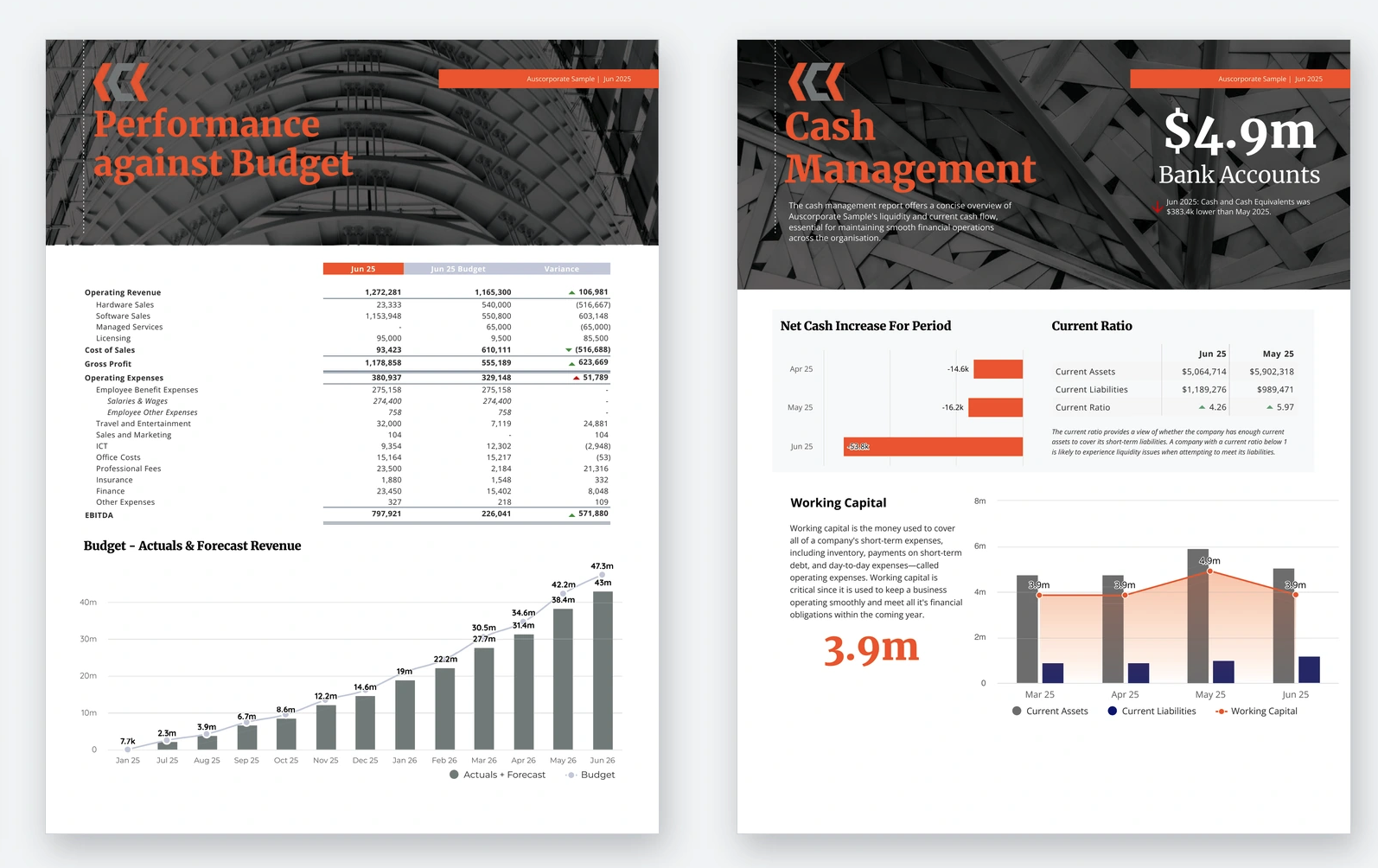
Profit and loss, balance sheet and cash flow reporting, with commentary that explains material movements and highlights matters requiring attention.
Budget and variance analysis
Actual results compared with budget, prior periods and relevant targets. Analysis of the drivers behind differences, including timing effects and recurring issues.
Cost and margin visibility
Analysis of revenue, direct costs, overhead allocations and contribution margins at the level that matters to your business.
Operational performance measures
Financial and operational KPIs that connect results to activity, such as utilisation, delivery costs, capacity and customer profitability.
Board and investor reporting
A consistent financial narrative covering performance, key risks, exceptions and decisions required, tailored to your reporting audience.
Management review and advice
A structured discussion of results, agreed actions and follow-up responsibilities, supported by commercial advice on emerging issues.
Why engage us?
Commercial judgment backed by experience.
Our management accounting services draw on Auscorporate’s wider CFO Advisory practice. We understand the questions that leaders need answers to. From understanding cash runways, to workforce capacity and productivity measures, to whether pricing strategies are producing results that mean your business will hit its targets.
We bring hands-on experience of CFO leadership, including capital allocation pressure, investor scrutiny, and an understanding that not everything goes to plan. We read the numbers and look for what they mean for the business and what management should do next.
We know what scaling looks like in practice whemn revenue is uneven, margins move and investor patience has limits. We recognise early signs that performance is drifting, that costs are rising faster than revenue, or that cash is being tied up in the wrong places. Then we make those signs visible in your monthly reporting before they become problems.
We work with your team’s knowledge of the business and add an outside perspective on what the results mean. The goal is a shared understanding of performance and a clear view of where management attention is needed.
What you can expect
Reporting built for decisions, not presentation. Each report answers the questions your investors, leadership and board are asking.
Commentary that explains the results. We set out what changed, why it changed and whether it is timing or a trend.
Industry-grounded analysis based on the real costs of operating in your sector.
Profitability insight by customer, contract, project, product or business unit.
Forward-looking measures that link results to cash, capacity and performance against plan.
Senior CFO judgement from people who have run businesses, not just analysed them.
Auscorporate’s clients don’t engage us for spreadsheets. They engage us for judgement informed by decades of commercial and financial leadership.
Case Studies
-

Case 1 | Financial Visibility, Cash Flow Oversight and Commercialisation Support for an emerging Manufacturing Client
An emerging design and manufacturing business progressing from research and development into early commercial sales required clear visibility over its financial performance, cash position and funding needs. While initial product sales demonstrated early commercial activity, revenue remained modest and the business continued to rely on grants, investor funding and seed investor support to meet operating costs and advance development.
Auscorporate prepared management accounts and financial analysis that brought together profitability, cash movements, creditor obligations and balance sheet performance. Our reporting distinguished early sales activity from grant income and highlighted the gap between recurring revenue and operating expenditure, giving leadership a clearer understanding of the company’s financial position as it pursued commercialisation.
During the reporting period, initial investor funding and the conversion of investor loans into equity strengthened the balance sheet and supported the settlement of significant outstanding obligations. Auscorporate’s analysis tracked these movements and their impact on liquidity, while highlighting that the improved cash position remained dependent on further funding, the collection of outstanding receivables and careful management of expenditure.
Our review also identified financial pressures requiring continued oversight, including substantial development commitments and a concentration of assets in capitalised development expenditure. We recommended detailed short-term cash flow forecasting, active monitoring of receipts and payments, and written documentation of any revised creditor arrangements. These recommendations gave management a practical framework for assessing funding priorities and managing commitments while the proposed capital raise progressed.
Through structured management reporting and commercially focused analysis, Auscorporate provided leadership with greater visibility over the relationship between funding, operating performance and development expenditure. The engagement established a clearer basis for decisions about cash allocation, financial commitments and the next stage of commercialisation, while keeping the company’s ongoing funding requirements firmly in view.
-

Case 2 | Management Reporting, Performance Trends and Commercial Clarity for a Hospitality Client
A hospitality business required clearer visibility over the factors driving its financial performance. With seasonal trading patterns, changing revenue streams and fluctuating operating costs, monthly sales figures alone did not provide enough insight into underlying profitability or the areas requiring management attention.
Auscorporate prepared management reporting that brought together financial performance, revenue composition, gross margins, labour costs and cash movements. By comparing monthly results with prior-year performance and longer-term trading trends, we provided a clearer view of how the business was performing and where financial pressures were emerging. This helped management assess whether recent movements reflected seasonal demand, changes in customer spending or increases in the cost base.
The reporting highlighted a critical relationship: stronger sales and improved gross margins did not necessarily translate into stronger earnings. Rising operating expenses, particularly labour costs, could absorb improvements in gross profit. By presenting revenue trends alongside cost movements and labour-to-revenue ratios, Auscorporate made these pressures visible and gave management a more informed basis for reviewing staffing expenditure and operating efficiency.
Analysis of revenue streams also showed how changes in beverage sales, food sales and function bookings influenced overall performance. Looking beyond total turnover helped explain why stronger activity in one area could be offset by weaker contributions elsewhere. Historical comparisons added context, allowing management to assess short-term improvements against broader trading patterns and identify areas requiring sustained attention.
These insights provided a practical basis for reviewing labour allocation, promotional spending and opportunities to increase function revenue. Cash and working capital reporting complemented the profitability analysis, highlighting the importance of managing payment commitments alongside day-to-day trading. Together, these measures gave management a clearer understanding of both operating performance and near-term financial demands.
Structured reporting and clear trend analysis, helped translate financial information into practical commercial insight. Auscorporate helped Management gained a stronger basis for identifying emerging pressures, challenging costs and prioritising opportunities to improve performance. The reporting connected financial outcomes with the activities behind them, supporting more informed decisions about the ongoing operation of the business.
-

Case 3 | Management Accounts that deliver Quarterly Trend Analysis, Profitability Insights and Performance Visibility for a Professional Services Client
A professional services firm required a clearer understanding of its financial performance beyond individual monthly results. With project-based revenue fluctuating between reporting periods, short-term movements could obscure the underlying direction of the business. Leadership needed visibility over whether changes in profitability reflected project timing, cost movements or sustained improvements in operating performance.
Auscorporate prepared quarterly trend analysis supported by monthly management accounts, bringing together revenue, gross profit, operating expenditure and earnings across multiple reporting periods. By comparing consecutive quarters, equivalent periods in prior years and rolling annual results, we provided a broader perspective on business performance. This allowed management to assess recent results against historical patterns and distinguish longer-term progress from individual trading peaks.
The analysis identified an improving longer-term earnings trend, supported by strong gross margins and operating costs growing more slowly than revenue. Employee costs had also reduced as a proportion of revenue, helping explain the improvement in profitability. Presenting these measures together showed how changes in revenue and the cost base flowed through to earnings, giving leadership a clearer understanding of the drivers behind margin growth.
Quarterly comparisons also brought emerging pressures into focus. Although the latest quarter remained ahead of historical averages on several measures, revenue and earnings had declined against both the preceding quarter and the equivalent period a year earlier. The reporting placed this slowdown in context, highlighting the importance of reviewing pipeline timing and expenditure rather than assuming earlier peak performance would continue. Separately identifying a non-recurring gain also helped management assess the strength of underlying trading results.
Monthly productivity reporting added operational context to the quarterly picture. Declining billable utilisation and increasing non-billable time highlighted areas requiring investigation, including whether reduced activity reflected softer demand or work yet to be billed. Connecting these indicators with financial trends gave management a more informed basis for reviewing workload allocation, billing practices and future capacity requirements.
Through structured quarterly analysis, Auscorporate gave leadership a clearer view of both the firm’s longer-term progress and its emerging performance pressures. The reporting translated fluctuating results into an understandable picture of growth, profitability and productivity, supporting more informed decisions about resourcing, cost control and future business priorities.
FAQs
We already have a bookkeeper or finance manager. How would you help?
We work alongside your existing team to augment their capabilities by closing gaps in reporting, analysis, and commercial advice. Your team contributes its knowledge and financial records, and we agree on where additional analytical capacity and senior input will be most useful.
Does this service include bookkeeping, payroll or tax compliance?
The focus of a management accounting service is reporting, analysis and advice. Responsibilities for transaction roll, compliance and month-end preparation are agreed at the outset of an engagement. Any additional support needed is scoped separately.
Can you provide dashboards?
Yes. Management accounts can take several forms, and dashboard reporting is one way we make financial information clear and practical. We can provide dashboards ranging from simple KPI summaries through to detailed reporting on profitability, working capital and rolling cash flow forecasts.
Each dashboard is tailored to your business and the decisions you need to make. This may include tracking revenue, margins, labour costs, billable utilisation, budget performance and cash requirements, with monthly and quarterly comparisons to highlight trends.
We also help you interpret the results, understand what is driving changes and identify where attention is needed. Whether you need a concise snapshot or a more detailed management view, our dashboards help turn financial data into informed business decisions.
Can you improve the reporting we already produce?
Yes. We can work with your existing management pack and develop the analysis and commentary needed to answer management’s questions. We also consider how reporting can be tailored to meet the needs of different stakeholders, for example, a department head report vs. a report that is intended to inform a sophisticated board risk committee.
Can you report on an individual project or business unit?
Yes. We can tailor reporting to an individual project, department or business unit, providing visibility over its revenue, costs, profitability and cash requirements.
While project reporting differs from business-level reporting, both rely on accurate financial information, clear budgets and consistent cost allocation. We bring a deep understanding of cost reporting and can work within your project management framework, including earned value models, to support performance monitoring and project governance.
Depending on your needs, reporting can include actual costs against budget, committed expenditure, forecast costs to complete and expected final margins. This helps you identify emerging variances, understand their impact and take action early, while keeping project or business unit performance connected to the broader financial position.
Can you deliver reports to our investors?
Yes. We have substantial experience in delivering reports that are keyed into the needs of inevstors. From addressing the tall asks of a venture capture fund supporting a startup to the needs of an investor that will determine the earn-out of a divestment. Beyond delivering reports, we provide expertise to help navigate the complexities of supporting investor inquiries, helping you build stronger relationships with your investors through our CFO Advisory practice.
Do you work with Start-ups?
Yes. We regularly work with founders and early-stage teams to help them model out financial scenarios, test assumptions and reduce the risks associated with high growth.
What we bring to a startup is deep experience in investor expectations, capital markets, commercial modelling and financial pragmatism.
We help founders strike the right balance between operating in a high-risk environment and capturing opportunities that are unique to an entrepreneurial context.
Can you help us meet reporting needs to our bank or financier?
Managing reporting to a bank or financier requires a level of sopistication to ensure covenants and reporting obligations are met as the conseqnce of failure can be catastroptic for a busienss. We have deep experience in the preapration of management reporting for banks, financiers. We also have experience in delivering reporting to governement authorities who provide specialist grant or capital support including to Export Finance Australia.
I have a model, and I just want to test my assumptions. Can you help?
Yes. Our CFO Advisory service is a sounding board for clients who have mature financial models but need an opinion or a level of assurance over key assumptions and more.